hydroponic ph management featured 1

Hydroponic pH Adjustment Guide: How Much pH Up and pH Down to Add

Home
»
Gardening Guides
»
Hydroponic pH Adjustment Guide
Quick Answer: To adjust hydroponic pH, you must measure the baseline pH, then add exactly 1 milliliter of pH Up or pH Down per gallon of water to swing the pH by roughly 0.5 points. Never add adjustment fluids directly to the roots. Always dilute the acid or base in a cup of water first, pour it into the main reservoir, stir vigorously for 15 minutes, and re-measure. You can calculate the exact milliliter dosage required for your tank using our free Hydroponic pH Calculator.

What Most pH Guides Miss (And What You Will Learn Here)

  • The Rebound Effect: Why adjusting pH before adding your fertilizers will force you to do it twice.
  • Micro-Nutrient Lockout: How a pH of 6.8 literally binds iron molecules so roots cannot absorb them, turning top leaves bright yellow.
  • The Dilution Rule: Why pouring pure Phosphoric Acid directly into your tank will instantly burn root hairs.
  • Logarithmic Math: Why lowering pH from 7.0 to 6.0 requires vastly more acid than lowering it from 6.0 to 5.0.
  • Drift Tolerance: Why letting your pH slowly swing between 5.5 and 6.2 is actually better than keeping it at a robotic 5.8 forever.
Macro view of testing pH in a hydroponic reservoir

Insights Most Growers Overlook

  • You must never mix pH Up (Potassium Hydroxide) and pH Down (Phosphoric Acid) in the same cup. Doing so creates a violent chemical neutralization reaction.
  • Adding fertilizers (Part A and Part B) will naturally lower the pH of your tap water significantly. Never adjust your pH until all nutrients are fully dissolved.
  • Reverse Osmosis (RO) water has zero buffers, meaning a single drop of acid will send the pH plummeting to 3.0. You must add Cal-Mag to RO water before adjusting pH.

Why pH Adjustment is Critical in Hydroponics

In soil gardening, the dirt acts as a massive chemical buffer, neutralizing extreme acids and bases while soil microbes break down nutrients slowly. In hydroponics, there is no buffer. The water is the only medium between the fertilizer salts and the delicate root hairs.

pH stands for “Potential of Hydrogen,” measuring how acidic or alkaline a liquid is on a scale from 0 to 14. If the water’s pH falls out of the target “sweet spot” (usually 5.5 to 6.3 for hydroponics), a chemical reaction occurs. The nutrient salts precipitate—meaning they physically bind together into solid particles that are too large to pass through the root cell walls. The plant can literally starve to death while floating in water packed full of fertilizer. This is known as “Nutrient Lockout.”

Understanding the Logarithmic pH Scale

The biggest mistake beginners make is treating the pH scale like a normal ruler. The pH scale is logarithmic, meaning every 1-point change represents a 10-fold increase or decrease in acidity. A pH of 5.0 is 10 times more acidic than 6.0, and 100 times more acidic than 7.0.

Because of this logarithmic curve, lowering your pH from 7.5 down to 6.5 takes a considerable amount of pH Down. But lowering it from 5.5 to 4.5 takes only a microscopic drop. This is why it is incredibly easy to overshoot your target and cause a wild, bouncing pH swing that stresses the crop.

How Much pH Up and pH Down to Add

A reliable baseline rule for commercial hydroponic fluids (like General Hydroponics) is: Add 1 milliliter (mL) of pH Down per gallon of reservoir water to lower the pH by 0.5 points. However, tap water buffering varies wildly by city. Always start by adding exactly half of your calculated dose, wait 15 minutes, and re-test.
General Dosage Guidelines for a 10-Gallon Reservoir
Current pH Level Target pH Level Product Needed Starting Dosage (10 Gal)
7.5 6.0 pH Down 20 mL (4 tsp)
7.0 6.0 pH Down 10 mL (2 tsp)
6.5 6.0 pH Down 5 mL (1 tsp)
5.0 5.8 pH Up 15 mL (3 tsp)
4.5 5.8 pH Up 25 mL (5 tsp)

Common Mistakes to Avoid

  • Mistake: Pouring concentrated acid directly over the root ball.
    Fix: This will chemically scorch the roots. Pour adjustments into the highest-flow area of the reservoir, far from the root mass.
  • Mistake: Testing the water 3 seconds after adding the acid.
    Fix: It takes time for the acid to neutralize the water’s alkalinity buffers. You must wait 15 minutes before taking an accurate reading.
  • Mistake: Playing pH ping-pong.
    Fix: If you overshoot and the pH drops to 4.5, do not immediately dump pH Up into the tank to fight it. Adding acid, then base, then acid creates a toxic buildup of sodium and potassium salts. Drain 50% of the tank and replace with fresh water instead.

The 5-Step Safe Adjustment Process

Testing pH levels with a digital pen

To protect your plants and avoid salt buildup, follow this strict protocol every time you adjust your reservoir:

  • Step 1: Mix all base nutrients, Cal-Mag, and silica first. Allow the tank to circulate for 10 minutes.
  • Step 2: Use a calibrated digital pH pen to take a baseline reading.
  • Step 3: Calculate your dosage. Using a syringe or pipette, pull the required amount of pH Down.
  • Step 4: Squirt the acid into a small cup of plain water to dilute it, then pour that cup slowly into a high-flow area of your reservoir.
  • Step 5: Wait 15 minutes for the chemical reaction to stabilize, then test again. Repeat if necessary.

Managing pH Drift: When Not to Adjust

Many beginners panic when they set their tank to exactly 5.8 on Monday, only to check on Tuesday and see it has drifted to 6.1. Do not adjust it! Plants absorb different elements at different pH ranges. For example, Manganese is absorbed best at 5.5, but Calcium is absorbed best at 6.2.

By allowing the pH to naturally “drift” up from 5.5 to 6.3 over the course of the week, the plant gets access to the full spectrum of micronutrients. You should only add pH Down when the tank drifts above 6.3 or 6.4.

Diagnosing pH Lockout Symptoms

Lockout Symptoms Based on pH Extremes
Current pH Element Locked Out Visual Symptom on Plant
Above 6.5 (Alkaline) Iron (Fe) New top leaves turn bright yellow while veins remain sharply green.
Above 6.5 (Alkaline) Manganese (Mn) Brown necrotic spots appear on middle leaves.
Below 5.4 (Acidic) Calcium (Ca) New growth is crinkled or deformed; blossom end rot on tomatoes.
Below 5.4 (Acidic) Magnesium (Mg) Older lower leaves turn pale yellow between the veins.
Rapid Fluctuations Total Lockout Plant growth stops entirely, roots may turn brown and slimy.

Calculate Your Exact pH Up/Down Dosage

The pH scale is logarithmic, meaning trial and error usually results in violent pH swings that stress your plants. Stop playing the guessing game and calculate the exact number of milliliters your specific reservoir needs. Use our free pH Calculator to instantly find your required dose of phosphoric acid or potassium hydroxide.

Save this guide for later!

Never crash your hydroponic reservoir again. Pin this pH dosage cheat sheet to your indoor garden board.

Save to Pinterest

Pin this pH dosage guide to Pinterest!

Frequently Asked Questions

While you can use white vinegar or lemon juice to lower pH in an absolute emergency, they are highly unstable organic compounds. They will break down rapidly, causing the pH to spike back up within 24 hours, and they introduce sugars that feed harmful root-rot bacteria. Stick to Phosphoric Acid.

If your pH drops daily, it usually means your plants are consuming more water than nutrients, leaving a higher concentration of acidic fertilizer salts behind. It can also be an early indicator of root rot (Pythium) bacteria releasing acidic waste into the water.

A slowly rising pH is actually normal and desirable. As healthy plants consume acidic fertilizers (like nitrogen) out of the water, the water becomes more alkaline. Extreme air stones (excessive oxygenation) can also drive off dissolved CO2, raising the pH.

ALWAYS adjust pH AFTER adding nutrients. Commercial fertilizers are highly acidic and will dramatically alter the pH of plain tap water. Adjusting beforehand is a complete waste of time and chemicals.

You must use a known 7.0 buffer solution and a 4.0 buffer solution. Never use tap water. Dip the probe into the 7.0 solution and press the calibrate button. Rinse with distilled water, then repeat with the 4.0 solution. Recalibrate monthly.

While paper test strips or liquid indicator drops work, they rely on color matching, making it very difficult to tell the difference between 5.5 and 6.0. In hydroponics, that 0.5 difference is massive. A digital pen is highly recommended.

Yes. Commercial pH Down is pure concentrated Phosphoric Acid, and pH Up is Potassium Hydroxide. They can cause severe chemical burns to skin and eyes. Always use pipettes or syringes to handle them, and never mix them together.

👨‍🌾

About the Author: Sarah Collins

Sarah Collins is a horticultural researcher with 8+ years of hands-on experience in soil ecology and organic amendment strategies. She designs tools and publishes guides at currentgardening.com to help growers optimize their harvests naturally.
Similar Posts

  • What Is EC in Hydroponics? Electrical Conductivity Guide for Growers

    Home » Gardening Guides » What Is EC in Hydroponics? Quick Answer: When it comes to what is ec in hydroponics, eC (Electrical Conductivity) measures exactly how much fertilizer salt is dissolved in your hydroponic water. A good baseline EC is 1.0 to 1.6 for leafy greens, and 2.0 to 3.0 for fruiting plants. Quickly convert your meter readings using ourEC/TDS Calculator, measure exact nutrient doses with the Nutrient Calculator, and ensure your water is balanced first with our pH Calculator. Insights Most Growers Overlook The Blind Spot of EC: EC only measures total dissolved salts; it cannot tell you the ratio of specific nutrients. High EC could just mean…

  • Hydroponic Lettuce Yield Guide: How Many Heads Per Square Foot?

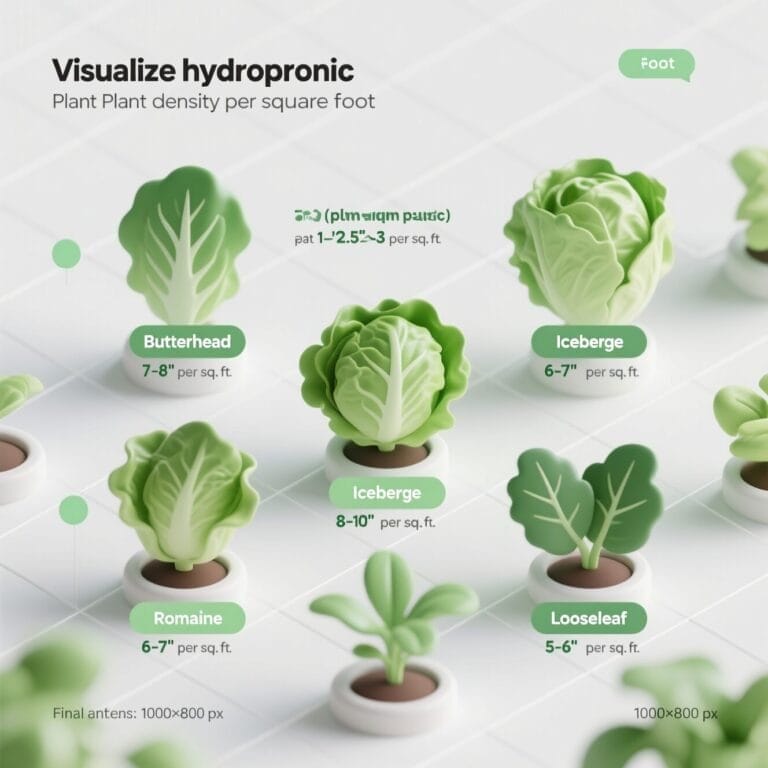
    Home > Hydroponic > Hydroponic Lettuce Yield Guide: How Many Heads Per Square Foot? Hydroponic System Typical Spacing Plants per sq. ft. Yield Characteristics Recommended Lettuce Nutrient Film Technique (NFT) 6-7 inches 2.5-3 Fast turnover, medium heads Leafy Greens, Romaine Deep Water Culture (DWC) 7-8 inches 2-2.5 Larger leaves, heavier heads Butterhead, Romaine Kratky Method 8-10 inches 1-2 Self-contained growth, full heads Butterhead, smaller Romaine Vertical Towers 4-6 inches (per pod) 4-6 (floor space) Maximized density, consistent harvest Leafy Greens, Small Butterhead Ebb & Flow (Flood & Drain) 6-8 inches 2-3 Versatile, good for various sizes Butterhead, Romaine, Looseleaf Parameter Optimal Range/Value Impact on Yield Notes EC (Electrical Conductivity) 1.0…

  • Kratky Method for Hydroponic Lettuce (No Pump, No Electricity)

    Kratky Method for Lettuce: Complete No NOTE: No H1 here. WordPress post title is the H1. Quick Answer: The Kratky method grows lettuce in a static nutrient solution with no pump or electricity — just a container, net pots, and correctly balanced nutrients at pH 5.8–6.2 and EC 1.0–1.3 mS/cm. Loose-leaf varieties are ready to harvest in 30–35 days; full heads take 45–55 days. What you’ll learn in this guide How the Kratky air gap works and why it replaces the need for a pump or air stone in a passive hydroponic system. Exact container sizes, net pot sizing, and plant spacing for baby-leaf, compact-head, and full-head lettuce varieties. The…

  • The Top 10 Herbs to Grow in Your Hydroponic Herbs Garden Indoors

    Complete Guide to Growing Herbs Hydroponically NOTE: No H1 here. WordPress post title is the H1. QUICK ANSWER Quick Answer: The easiest herbs to grow hydroponically are basil, mint, cilantro, and chives — all ready to harvest in 3–6 weeks. Keep pH between 5.5 and 6.5 and EC between 0.8 and 2.0 mS/cm depending on the herb. Any system works — DWC, NFT, or Kratky — with 14–16 hours of light daily. KEY TAKEAWAYS What you’ll learn in this guide Exact pH, EC, and light requirements for 10 different herbs in one reference table Which hydroponic system works best for each herb — DWC, NFT, Kratky, or aeroponics How to…

  • Hydroponic Lettuce Nutrient Guide: EC, pH, and Fertilizer Ratios Explained

    Hydroponic Lettuce Nutrient Guide: EC, pH and Fertilizer Ratios NOTE: No H1 here. WordPress post title is the H1. Quick Answer: Hydroponic lettuce needs a nutrient solution at pH 5.8–6.2 and EC 0.8–1.0 mS/cm for seedlings, rising to 1.2–1.6 mS/cm for mature plants. The most important individual nutrients are nitrogen (100–150 ppm), potassium (150–200 ppm), and calcium (80–120 ppm) — calcium being the single element most responsible for tip burn when it falls short. What you’ll learn in this guide The exact EC range for each lettuce growth stage — seedling (0.8–1.0), vegetative (1.0–1.4), and mature head (1.2–1.6 mS/cm) — and why going above 1.8 causes bitterness. Why pH 5.8–6.2…

  • Optimal Plant Density: Maximizing Hydroponic Growth

    Home » Gardening Guides » Plant Spacing Guide Quick Answer: When it comes to optimal plant density, correct plant spacing is determined by the mature canopy size of the crop, not the size of the seedling. Planting crops too close together causes severe competition for light, water, and nutrients, while restricting airflow and inviting fungal diseases like powdery mildew. Stop guessing spacing grids and use our freePlant Spacing Calculator to instantly determine exactly how many plants can safely fit into your raised beds or hydroponic system. What Most Spacing Guides Miss (And What You Will Learn Here) The Square Foot Gardening Myth: Why blindly following the 1×1 grid system fails…

Leave a Reply

Your email address will not be published. Required fields are marked *